Affiliation
- 1 Department of Animal Science, Northfield University
- 2 Institute of Animal Physiology, Eastbrook College
Abstract
Background: Heat load is a growing constraint on dairy cattle health, welfare and productivity.
Approach: This narrative review integrates established physiological and welfare literature with practical mitigation principles.
Key findings: Heat stress alters thermoregulation, feeding behaviour, endocrine function and rumen performance. Respiration rate, panting, body temperature, shade use and production records should be interpreted together. Shade, ventilation, effective evaporative cooling, reliable drinking water and ration management form a layered response.
Conclusion: Heat-abatement plans should be triggered early, monitored with animal-based indicators and adapted to local humidity, housing and herd risk.
Keywords
Full text
1. Why heat load matters
Dairy cows continuously produce metabolic heat, and high-yielding animals have less capacity to dissipate it when air temperature and humidity rise. West [1] described linked reductions in dry-matter intake, milk output and reproductive performance; later welfare synthesis showed that the consequences extend to thirst, discomfort, altered resting and competition for cooling resources [2].
2. Physiological response
Cows seek shade, stand more, increase respiratory rate and redirect blood toward the skin. Prolonged exposure raises maintenance requirements while feed intake falls. Humidity limits evaporative heat loss, so the same air temperature can produce different risks across climates.
Temperature–humidity indices are useful screening tools, but animal-based observations determine whether the herd is coping.
3. Indicators for daily monitoring
Useful early indicators include respiration rate, panting score, drooling, crowding around water, reduced lying time and changes in feed intake. Rectal or rumen temperature offers confirmation where practical. Milk yield is important but is a lagging indicator. Monitoring should include fresh cows, high producers and sick animals because group averages can conceal individuals at greater risk [2].
4. A layered mitigation plan
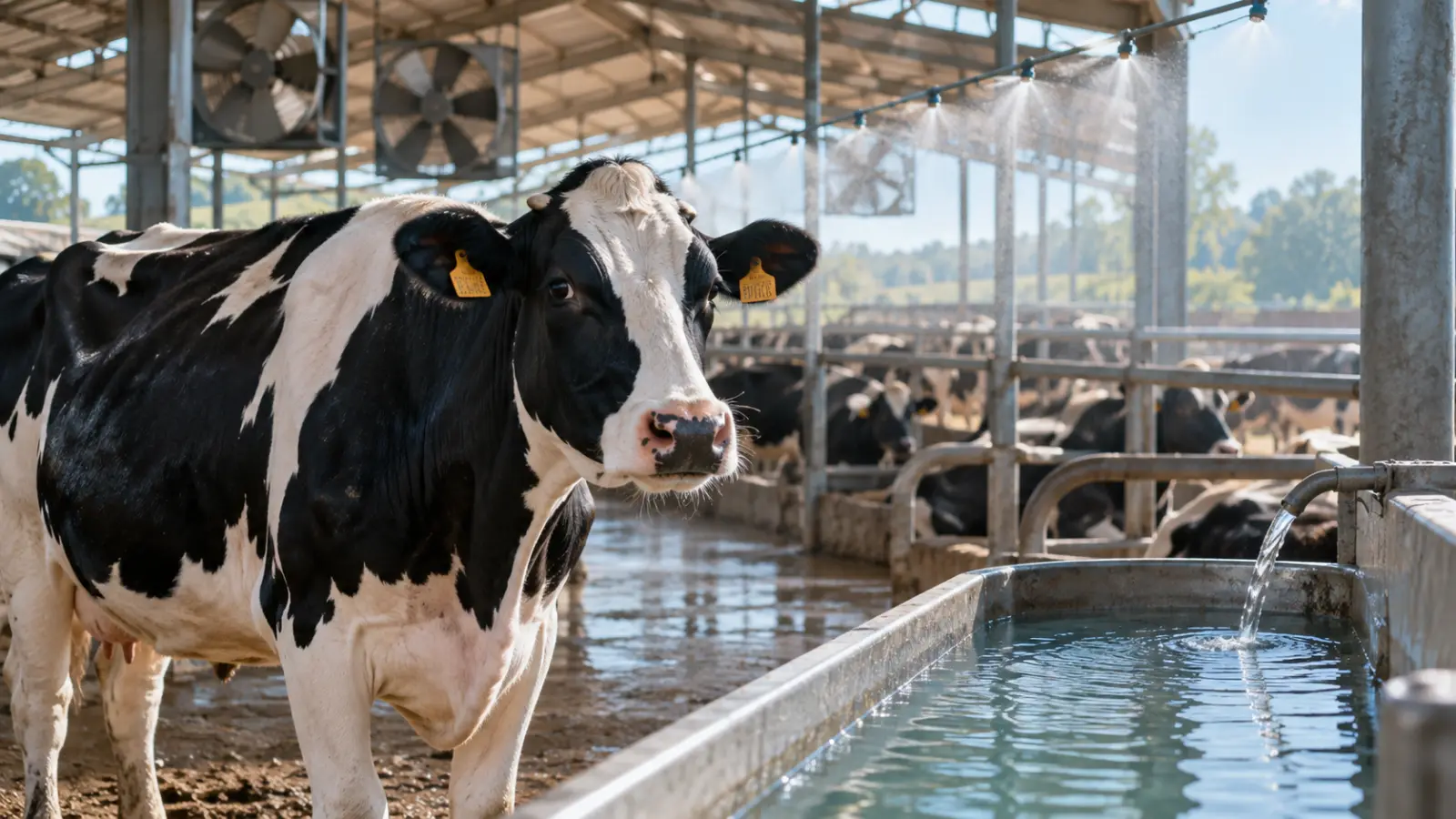
Shade reduces solar radiation but does not remove accumulated body heat. Air movement increases convective loss; sprinklers or soakers cool the skin when they wet the coat sufficiently and fans promote evaporation. Fine mist is less useful in humid conditions. Cows require generous access to clean water, especially after milking.
Feeding during cooler hours, maintaining ration stability and preventing sorting can help preserve intake. Diet changes cannot replace physical cooling. Collier and colleagues [3] emphasised that environmental control must match housing, climate and the animal’s changing heat production.
5. Implementation checklist
- Use weather forecasts to activate cooling before visible distress.
- Inspect airflow and water delivery at cow level.
- Record respiration and panting in a consistent sentinel group.
- Prioritise holding areas, close-up pens and fresh-cow groups.
- Review the plan after every heat event.
6. Conclusions
The strongest programmes combine environmental measurements, direct observation and production data. Early action is more effective than attempting to reverse accumulated heat load.
References
- West JW. Effects of heat-stress on production in dairy cattle. J Dairy Sci. 2003;86(6):2131–2144. https://doi.org/10.3168/jds.S0022-0302(03)73803-X Google ScholarCrossref
- Polsky L, von Keyserlingk MAG. Invited review: Effects of heat stress on dairy cattle welfare. J Dairy Sci. 2017;100(11):8645–8657. https://doi.org/10.3168/jds.2017-12651 Google ScholarCrossref
- Collier RJ, Dahl GE, VanBaale MJ. Major advances associated with environmental effects on dairy cattle. J Dairy Sci. 2006;89(4):1244–1253. https://doi.org/10.3168/jds.S0022-0302(06)72193-2 Google ScholarCrossref
About the authors

License
Copyright (c) 2026 The Authors
CC BY 4.0 This work is licensed under a Creative Commons Attribution 4.0 International License.