Affiliation
- 1 Laboratory Animal Centre, Northfield University
Abstract
Objective: To connect enrichment design with measurable rabbit welfare outcomes.
Synthesis: Rabbits are social, exploratory and highly motivated to forage, hide and adopt upright postures. Effective programmes provide usable space, social opportunity, refuges, manipulable fibre and choice.
Assessment: Resource provision alone is insufficient; behaviour, physical health, human–animal interaction and use of resources must be monitored.
Conclusion: Enrichment should be treated as a testable refinement programme with predefined outcomes, not as a static object list.
Keywords
Full text
1. Behavioural needs
Domestic rabbits retain motivations to forage, gnaw, explore, rest in concealment and interact socially. Barren housing restricts these opportunities. Hansen and Berthelsen [1] demonstrated that structural enrichment changes the behaviour of caged rabbits, but the value of any item depends on whether animals can and do use it.
2. From objects to opportunities
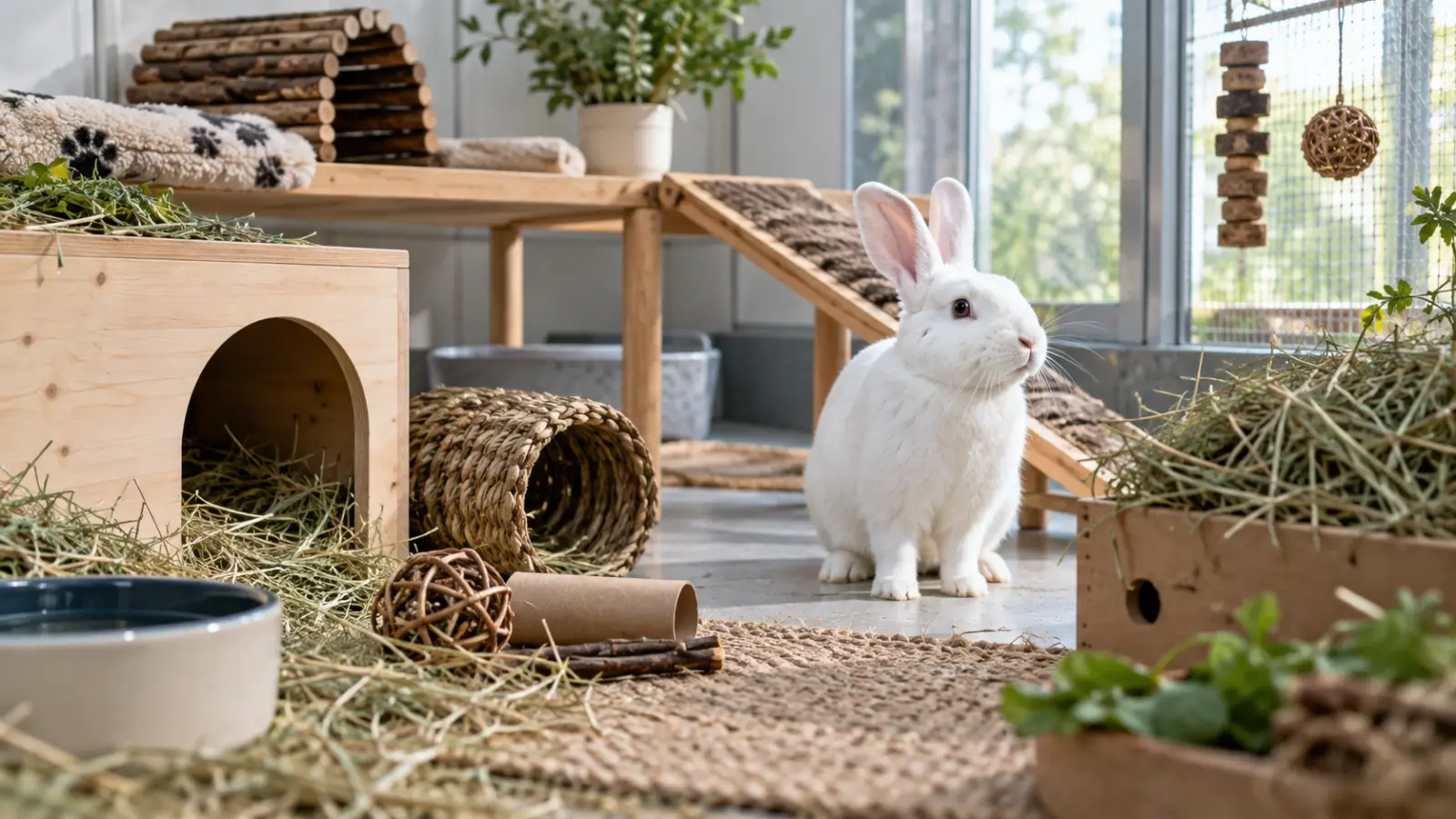
An enrichment programme should describe the opportunity it creates. A platform can provide lookout, exercise and usable floor area; a refuge offers control over exposure; hay supports foraging and manipulation. Pair or group housing offers social contact where animals are compatible. Baumans [2] emphasised integration with husbandry and research requirements.
3. Welfare assessment
Input measures such as dimensions or number of objects are easy to audit but cannot establish the animal’s experience. Outcome measures should include posture, locomotion, social behaviour, hiding, interaction with enrichment, abnormal repetitive behaviour, injuries, body condition, pododermatitis and clinical health.
4. Choice and control
Animals benefit when they can choose between exposed and sheltered areas or withdraw from social contact. Resources must not create competition. Verga and colleagues [3] connected housing and management with both physiology and behaviour, reinforcing the need to evaluate the complete system.
5. Scientific quality
Enrichment may change variability, but standardisation does not require impoverishment. A well-described environment improves reproducibility. ARRIVE 2.0 asks authors to report husbandry and housing details that may influence outcomes [5].
6. A practical cycle
- Define the welfare risk.
- Select safe resources that create a relevant opportunity.
- Set observable success and adverse-effect criteria.
- Record uptake across animals and time.
- Modify the programme using observations.
EFSA’s review [4] supports combining resource- and animal-based measures rather than relying on a single housing label.
7. Conclusions
Good enrichment is dynamic, evidence-led and specific to the rabbits and procedures in front of the care team. Its success is demonstrated by animal outcomes.
References
- Hansen LT, Berthelsen H. The effect of environmental enrichment on the behaviour of caged rabbits (Oryctolagus cuniculus). Appl Anim Behav Sci. 2000;68(2):163–178. https://doi.org/10.1016/S0168-1591(99)00093-9 Google ScholarCrossref
- Baumans V. Environmental enrichment for laboratory rodents and rabbits: requirements of rodents, rabbits, and research. ILAR J. 2005;46(2):162–170. https://doi.org/10.1093/ilar.46.2.162 Google ScholarCrossref
- Verga M, Luzi F, Carenzi C. Effects of husbandry and management systems on physiology and behaviour of farmed and laboratory rabbits. World Rabbit Sci. 2007;15(3):115–125. https://doi.org/10.4995/wrs.2007.600 Google ScholarCrossref
- EFSA Panel on Animal Health and Welfare. Health and welfare of rabbits farmed in different production systems. EFSA J. 2020;18(1):5944. https://doi.org/10.2903/j.efsa.2020.5944 Google ScholarCrossref
- Percie du Sert N, Hurst V, Ahluwalia A, Alam S, Avey MT, Baker M, et al. The ARRIVE guidelines 2.0: updated guidelines for reporting animal research. PLoS Biol. 2020;18(7):e3000410. https://doi.org/10.1371/journal.pbio.3000410 Google ScholarCrossref
License
Copyright (c) 2026 The Authors
CC BY 4.0 This work is licensed under a Creative Commons Attribution 4.0 International License.