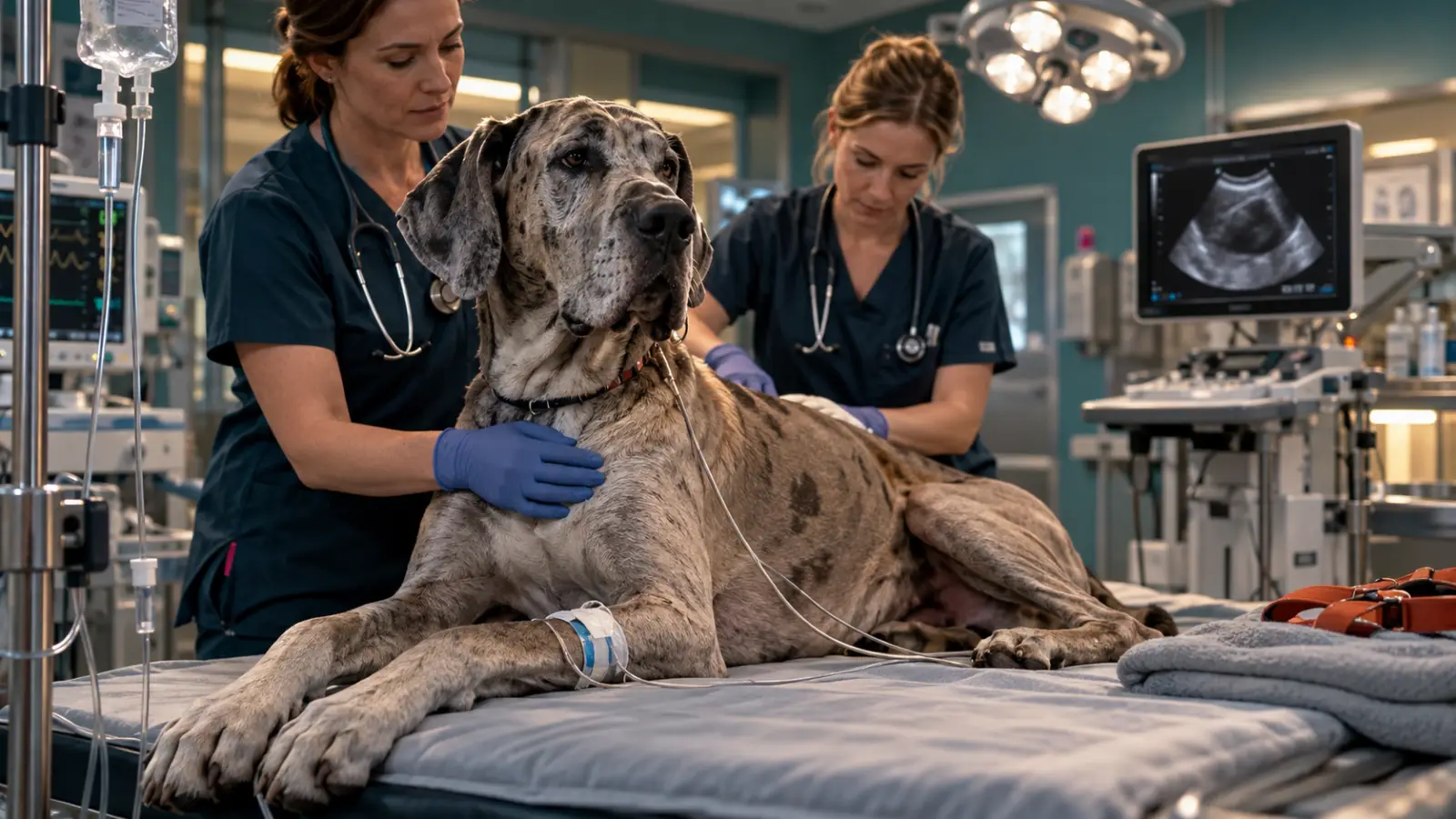
Affiliation
- 1 Small Animal Teaching Hospital, Riverside Veterinary School
- 2 Department of Surgery, Riverside Veterinary School
Abstract
Importance: Gastric dilatation–volvulus (GDV) is a rapidly progressive, life-threatening emergency.
Recognition: Non-productive retching, abdominal distension, restlessness, hypersalivation and circulatory compromise in a predisposed dog warrant immediate assessment.
Management: Resuscitation and gastric decompression proceed in parallel, followed by surgery to assess viability, correct the volvulus and perform gastropexy.
Prevention: Breed and family history inform risk conversations; prophylactic gastropexy can reduce volvulus risk in selected dogs but does not prevent simple gastric dilatation.
Keywords
Full text
1. Clinical importance
GDV combines rapid gastric distension with rotation of the stomach. Venous return falls, tissue perfusion deteriorates and reperfusion injury can affect multiple organs. Sharp and Rozanski [2] describe cardiovascular effects that explain why apparently alert dogs may decline quickly. This article is educational and does not replace immediate veterinary assessment.
2. Recognition and triage
Typical signs include repeated unproductive retching, salivation, restlessness, abdominal enlargement and pain. Weak pulses, pale mucous membranes, tachycardia, altered mentation and collapse indicate shock. Deep-chested large and giant breeds carry higher risk, but signalment should never rule out disease. Glickman and colleagues quantified breed-related patterns [1].
3. Diagnosis
Treatment should not be delayed for an extensive work-up. Right lateral abdominal radiography commonly demonstrates compartmentalisation of the gas-filled stomach and helps distinguish volvulus from simple dilatation. Laboratory evaluation guides resuscitation; serial lactate can help assess response but should not be interpreted alone.
4. Stabilisation and decompression
Large-bore intravenous access, balanced fluid resuscitation, oxygen and analgesia are instituted promptly. Gastric decompression may be attempted by orogastric tube; percutaneous decompression is used when passage is not possible or would delay care. Reassessment is essential.
5. Surgery
Definitive treatment requires exploratory surgery. The stomach is returned to normal position and assessed for viability; clearly nonviable tissue is resected when necessary. Gastropexy fixes the stomach to the right body wall and is critical because correction without fixation carries high recurrence risk.
6. Postoperative priorities
Monitoring focuses on perfusion, pain, electrolytes, acid–base status and ventricular arrhythmias. Prognosis varies with disease duration, severity and the presence of gastric necrosis.
7. Prevention
Risk has a heritable component and is influenced by conformation, age and family history [3]. Prophylactic gastropexy may be discussed for high-risk dogs. Owners should understand that it aims to prevent volvulus, not every episode of distension, and that retching or distension remains an emergency.
8. Conclusions
Outcome depends on early recognition, simultaneous resuscitation and decompression, timely surgery and attentive postoperative care.
References
- Glickman LT, Glickman NW, Schellenberg DB, Raghavan M, Lee T. Incidence of and breed-related risk factors for gastric dilatation-volvulus in dogs. J Am Vet Med Assoc. 2000;216(1):40–45. https://doi.org/10.2460/javma.2000.216.40 Google ScholarCrossref
- Sharp CR, Rozanski EA. Cardiovascular and systemic effects of gastric dilatation and volvulus in dogs. Top Companion Anim Med. 2014;29(3):67–70. https://doi.org/10.1053/j.tcam.2014.09.007 Google ScholarCrossref
- Bell JS. Inherited and predisposing factors in the development of gastric dilatation volvulus in dogs. Top Companion Anim Med. 2014;29(3):60–63. https://doi.org/10.1053/j.tcam.2014.09.002 Google ScholarCrossref
License
Copyright (c) 2026 The Authors
CC BY 4.0 This work is licensed under a Creative Commons Attribution 4.0 International License.